3 Fiber Mistakes You’re Probably Making (and How to Correct Them)

Made it a mission to increase your fiber intake? That’s great news, especially as most Americans don’t get enough of it daily. But before you hop aboard the fibermaxxing trend, it’s important to have a game plan to optimize your intake (and minimize digestive distress in the process).
There’s a handful of mistakes people make when it comes to their fiber game. To help you get ahead of things, we asked dietitians what to be careful of and how to avoid making the most common fiber mistakes. Plus: a fiber-forward smoothie recipe that’ll inch you towards your daily goals.
3 Common Fiber Mistakes
1. Increasing intake too quickly
Suddenly supercharging your intake can be a recipe for disaster—yet it’s still a fiber mistake a lot of people make, especially given the recent virality of going from 0 to 60 with fibermaxxing. “While the enthusiasm is great, increasing your fiber intake too quickly from a small amount to a large amount can increase your risk of digestive side effects like gas and bloating,” warns Sarah Glinski, RD, a dietitian specializing in gut health and owner of Gut-Friendly Nutrition in Langley, British Columbia. “This often causes people to mistakenly believe they can’t tolerate high-fiber foods.”
To get around this, Glinski suggests adding only a few grams of fiber to your diet every few days. Or, to make things easier, you can simply add one new fibrous food to your diet every few days—think an apple with lunch to start, a tablespoon to chia seeds to your morning smoothie by the end of the week, followed by a handful of berries to your yogurt bowl the week after.


Gabrielle Kishner, MS, RD, CDN, dietitian and founder of Nutrition By Gabrielle in New York, New York, also suggests spacing out your intake throughout the day, rather than getting the bulk of your fiber in a single meal. (Read: Drinking your fiber and eating a three-bean chili right after probably isn’t the best idea.)
2. Not drinking enough fluids

One of the golden rules of increasing your fiber is to increase your fluid intake alongside it. “Fiber needs water to work properly,” says Kishner. “When you eat more fiber, drinking enough water helps keep your stool soft, bulky, and easier to pass. Without enough water, increasing your fiber too quickly can actually make constipation worse and lead to hard, pebble-like stools that are difficult to pass.”
The solution is simple: Drink up throughout the day. If you struggle to stay on top of your hydration game, Glinski suggests downloading a hydration app or setting reminders on your phone. You can also consider buying a large jug or bottle that’ll help you keep track of how much fluid you’re actually consuming day in and day out.
And in case water isn’t your favorite beverage, rest assured that other sources count, too. “Sparkling water, juice, milk, tea, and even the water from hydrating foods like watermelon and cucumber all count towards your daily intake,” Glinski shares.
3. Not diversifying your fiber sources
If you’re the type to eat the same thing every day like clockwork, here’s a friendly reminder that you should switch things up—including when it comes to fiber.
The first reason comes down to giving your gut microbiome adequate fuel and encouraging diversity. “Since different microbes rely on different fuel sources, getting your fiber from a wide variety of different sources ensures that you’re feeding more different microbes,” Glinski shares.
Next, different types of fiber—like soluble vs. insoluble fiber—offer different benefits. While many foods contain both, they often contain more of one than the other. “Soluble fiber, found in foods like chia seeds, psyllium husk, and oats, is important because it forms a gel in your digestive tract when it comes into contact with fluid. This helps keep your poop soft and easy to pass,” says Glinski. Soluble fiber is also the most effective fiber for lowering LDL cholesterol (aka the “bad” kind). Then there’s insoluble fiber—good sources of which include whole wheat products, nuts, beans, and cauliflower, says Kishner—which add bulk to your stool and are thus a great option for those dealing with constipation.

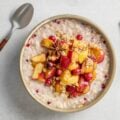
To avoid making this fiber mistake, aim to diversify your sources as much as possible—even within similar categories. For instance, add blueberries to your oatmeal one week and raspberries the next. Switch up the types of beans in your chili recipes. Rotate between different cruciferous veggies and starches as dinner sides. Switch up your salad bar order every time you dine out. Throw chia seeds into your smoothie on weekdays and flaxseed on weekends. Buy—or better yet, DIY—different types of trail mix to snack on.
Glinski also recommends aiming to eat 30 plants per week, spanning fruits, vegetables, whole grains, beans, nuts, and seeds. “This can be a fun way to see how much variety you’re getting without having to track every single food you eat,” she says. “Simply add a point to your tally each time you eat a different plant food, then add up your points at the end of the week.”
A Fiber-Forward Berry Banana Protein Smoothie
Smoothies are among the easiest (and tastiest!) ways to boost your fiber intake. For the sake of mixing things up—both figuratively and literally—we asked Kishner to share one of her go-to fiber-packed smoothie recipes.
“This smoothie has about 10 grams of fiber from a variety of foods, including fruit, vegetables, nuts, and seeds,” she says. (And yes, they span a mix of both soluble and insoluble fiber.) “It’s an easy way to add more fiber to your day while also getting protein and other important nutrients.”
Ingredients
- 1 cup of milk of choice
- ½ banana
- ¼ cup of frozen berries
- 1 cup of Greek yogurt or 1 scoop of protein powder
- Handful of fresh or frozen spinach
- 1 tablespoon of nut butter
- 1 tablespoon of chia or flax seeds
- A drizzle of honey for sweetness
- Ice
Method: Mix all of the ingredients in a blender, and enjoy.