
Creatine isn’t just for gym bros—and taking it doesn’t need to become another complicated wellness ritual.
Creatine is nothing new, but you may have noticed that it’s taking up serious real estate all over your social media feeds and TikTok. If your immediate reaction is, Wait, isn’t that the stuff bodybuilders take? you’re definitely not alone.
For years, creatine was marketed almost entirely to young male athletes, but the supplement itself can benefit far more than just gym bros. In fact, it may be especially relevant for women, particularly those over 40, who tend to consume less creatine through their diets and experience changes in muscle mass and strength as they age, explains Jerry Bailey, DC, LAc, certified nutritionist, acupuncturist, chiropractic, and functional medicine physician at Lakeside Holistic Health.
What is Creatine?
Creatine isn’t some foreign substance you’re suddenly introducing to your body—it already makes it on its own from three amino acids: arginine, glycine and methionine. Most of it is stored in your muscles, with smaller amounts in your brain and other tissues. You can also get creatine through foods like meat and fish.*
Its main job is to help your cells quickly replenish their energy, Bailey explains. Your cells run on something called ATP, which gets used up fast whenever your muscles are working hard. Creatine helps make more of it available when you need it. Think of it as a backup battery your body can tap into during a workout or any other quick burst of activity. Research has already established that creatine can help with strength, workout performance, recovery and holding onto lean muscle, and newer studies are even looking into what it could do for brain health and healthy aging.
Can You Put Creatine in a Smoothie?
The best part? You don’t need to time your creatine down to the minute or choke it down with plain water at the gym. Sure, it works just fine in plain water, but blending it into something you already drink regularly that tastes a bit better can make it much easier (and more enjoyable) to take down each day. Plus, when it comes to creatine, consistency matters far more than taking it at the perfect time, notes functional nutritional therapy practitioner Tansy Rodgers, FNTP.
A smoothie is actually one of Rodgers’ favorite ways to take it because it pairs naturally with ingredients like fruit, Greek yogurt, protein powder and milk, giving you a mix of carbohydrates and protein that complements your muscle-supporting goals. “Just blend it and drink it soon after; if you prep your smoothies well in advance, add the creatine shortly before drinking rather than letting it sit dissolved for hours,” she says.
How Much Creatine Should You Add to a Smoothie?
For most healthy adults, experts recommend 3 to 5 grams of creatine monohydrate daily. Monohydrate is the key word here: It’s the form with the most research behind it, and pricier alternatives haven’t been shown to work better, Bailey explains.
You may have heard about “loading,” which typically involves taking around 20 grams daily for several days to fill your muscles’ creatine stores faster. Unless you’re an athlete looking for more immediate results, it’s usually unnecessary, according to Bailey who says taking 3 to 5 grams consistently will get you to the same place—it may just take a few weeks longer. As Bailey puts it, “There is no prize for getting saturated in five days instead of four weeks.”
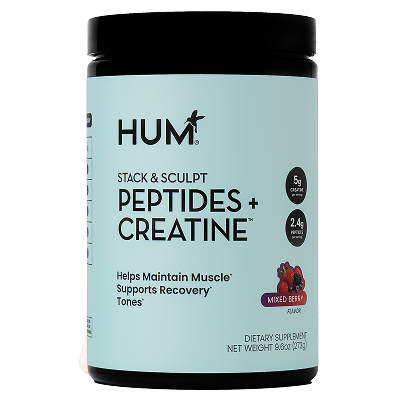
Each scoop of HUM’s Stack & Sculpt contains 5 grams of creatine monohydrate, along with 2.4 grams of PeptiStrong®, a plant-based peptide complex derived from fava beans. No measuring, loading or creatine math required—just add one scoop to your smoothie daily, including on rest days.
3 Creatine Smoothie Recipes to Try
All three recipes make one serving and include one full scoop of mixed-berry Stack & Sculpt.
1. Mixed Berry Vanilla Creatine Smoothie
Creamy, sweet and packed with berry flavor, this is the low-effort breakfast smoothie you can throw together while you’re still waiting for your coffee to kick in. Greek yogurt adds protein, while the fruit brings the carbohydrates—exactly the combination Bailey recommends pairing with creatine to support your muscle-building goals.
Ingredients:
- 1 scoop HUM Stack & Sculpt
- ¾ cup unsweetened vanilla almond milk or milk of choice
- ½ cup plain Greek yogurt
- ½ frozen banana
- ½ cup frozen mixed berries
- 1 tablespoon chia seeds
- Ice, as needed
How to make it:
- Add all ingredients to a high-powered blender.
- Blend until smooth and creamy, adding another splash of milk if needed.
- Pour into a glass and enjoy soon after blending.
2. Chocolate-Covered Cherry Creatine Smoothie
Chocolate-covered cherries in smoothie form? Say less. This recipe combines dark cherries, cocoa powder and almond butter for a dessert-inspired smoothie that still brings plenty of protein.
Ingredients:
- 1 scoop HUM Stack & Sculpt
- ¾ cup milk of choice
- ½ cup plain Greek yogurt
- ¾ cup frozen dark cherries
- ½ frozen banana
- 1 tablespoon unsweetened cocoa powder
- 1 tablespoon almond butter
- Pinch of salt
- Ice, as needed
How to make it:
- Add all ingredients to a high-powered blender.
- Blend until completely smooth, adding more milk to reach your preferred consistency.
- Pour into a glass and drink immediately.
3. PB&J Creatine Smoothie
This one tastes like the sandwich you loved as a kid, just more supportive of your current strength goals. Stack & Sculpt’s mixed-berry flavor handles the “jelly,” while strawberries, peanut butter and Greek yogurt turn it into a genuinely satisfying smoothie.

Ingredients:
- 1 scoop HUM Stack & Sculpt
- ¾ cup milk of choice
- ½ cup plain Greek yogurt
- 1 cup frozen strawberries
- ½ frozen banana
- 1 tablespoon natural peanut butter
- ½ teaspoon vanilla extract
- Ice, as needed
How to make it:
- Combine all ingredients in a blender.
- Blend until smooth and creamy.
- Add an extra splash of milk if the smoothie is thicker than you like, then pour and enjoy.
Who Should Talk to a Healthcare Provider Before Taking Creatine?
Creatine has a strong safety record for most healthy adults, but that doesn’t mean it’s automatically appropriate for every person in every situation.
Laura M. Ali, MS, RDN, LDN, a culinary nutritionist based in Pittsburgh recommends checking with your healthcare provider before taking creatine if you have kidney disease, reduced kidney function, a history of significant kidney problems or abnormal kidney test results. You should also ask before taking it if you use medications that may affect kidney function, including certain immunosuppressants, antivirals or antibiotics, or if you regularly take high doses of NSAIDs.
Bailey recommends pregnant or breastfeeding women speak with their providers as well. Creatine during pregnancy is an interesting area of research, but there still aren’t enough controlled human safety trials to routinely recommend supplementation, he explains.
He also advises involving a healthcare provider if you have bipolar disorder or a history of mania or hypomania, significant liver or metabolic disease, a complex chronic condition or take several prescription medications.
The Takeaway
Creatine doesn’t need to be complicated. For most healthy adults, that means choosing creatine monohydrate, taking 3 to 5 grams consistently, skipping the loading phase unless there’s a specific reason for it and pairing supplementation with resistance training and adequate protein.
You also don’t need to obsess over whether you drink your smoothie at 7 a.m. or immediately after your final squat. Pick the recipe you’ll actually want to make, take it regularly and let consistency do its thing.


