“Fast metabolism” is usually talked about as a matter of luck, as if some people were born burning more calories than everyone else. Genetics do play a part, but one major factor is largely in your control: muscle. Understanding what it does and how to protect it changes how you think about weight management, energy, and long-term metabolic health
What “Fast Metabolism” Actually Means
When people say this, they usually mean a higher resting metabolic rate (RMR), the energy your body spends at rest to keep essential systems running: circulation, breathing, temperature, cell repair. Your total daily burn is that baseline plus movement plus the energy used to digest food.
Lean muscle influences all three. It’s metabolically active tissue, and pound for pound it burns roughly three times as many calories at rest as fat does. The difference per pound is modest, but it compounds around the clock. It’s also one of the few parts of your metabolism you can meaningfully change.
Why The Scale Can Mislead You
Muscle is denser than fat, so a pound of muscle takes up less space than a pound of fat. That’s why someone who is strength training can see the scale stay flat, or even creep up, while their body composition improves. Weight alone can’t tell you whether you gained muscle or lost it.
If you start lifting and the number rises, don’t panic. It may be a sign you’re building the very tissue that supports your metabolism, especially valuable for women, who find muscle harder to build and easier to lose with age. Track how your clothes fit, how your strength is progressing, and how your energy feels alongside the scale. (A small early uptick can also come from creatine, which draws water into muscle cells. That’s expected and not fat gain.)
Muscle Does More Than Burn Calories
- It manages blood sugar. Skeletal muscle is one of the primary tissues that pulls glucose out of your bloodstream after a meal. More muscle means more capacity to handle carbohydrates efficiently, which supports steadier energy and more predictable hunger and fullness.
- It improves metabolic flexibility. Muscle helps your body switch between carbohydrates and fat as fuel, depending on what’s available and what you’re doing. That flexibility is a hallmark of an efficient metabolism.
- It communicates. Working muscle releases signaling molecules that “talk” to other tissues, including fat, liver, and brain. This is an active area of research, but it helps explain why staying strong is associated with feeling more energized, resilient, and regulated overall.
Why Preserving Muscle Matters When You’re Losing Weight
This is where many calorie-cutting plans quietly backfire. If calories drop sharply and muscle isn’t protected with enough protein and resistance training, your body can lose lean mass along with fat. Less muscle means a lower resting burn, and a lower resting burn makes results harder to maintain. The effect is compounded by age: muscle loss begins gradually in our 30s and can accelerate around menopause.
Protecting muscle during weight loss keeps your metabolic rate from dropping along with the number on the scale.
How to Build and Maintain Muscle
You don’t need extremes. You need consistency.
- Lift regularly. Aim for three to four strength sessions a week. Beginners can start with bodyweight, and if you’re more seasoned, keep progressing the load so your muscles keep adapting.
- Prioritize protein at every meal. HUM’s dietitians recommend 20 to 30 grams of protein per meal, calling it the most underrated lever for lean muscle. Spreading it throughout the day gives your muscles repeated signals to build.
- Eat enough. Chronic under-eating slows your metabolism by promoting muscle loss. Think of food as fuel for growth, recovery, and hormone balance.
- Include carbohydrates. They replenish muscle glycogen and support the training that preserves muscle.
- Recover. Muscle is built between sessions, so rest days and sleep are part of the plan.
Where Stack & Sculpt Fits In
Nutrition and training do the heavy lifting. HUM’s newest formula, Stack & Sculpt, is designed to support them. It pairs two clinically studied ingredients: 5g of creatine monohydrate, the standard daily serving behind decades of published research, and 2.4g of PeptiStrong®, a plant-based peptide complex derived from fava beans.
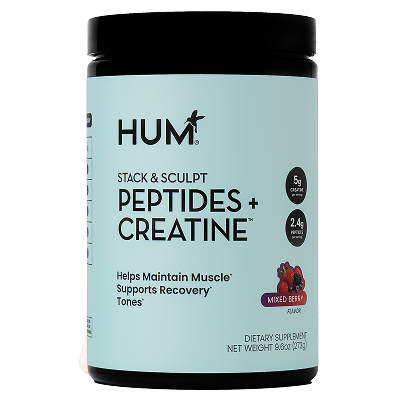

The two work on different sides of the equation. Creatine helps muscles produce energy for hard efforts, but as HUM’s team puts it, it doesn’t tell your muscles what to do with that energy. That’s where the peptides come in. In human research at the same 2.4-gram daily dose found in Stack & Sculpt, PeptiStrong significantly reduced myostatin, a protein that acts as a natural brake on muscle growth. And in an 8-week clinical study, PeptiStrong combined with resistance training led to a 17% greater increase in leg strength than resistance training alone.
The goal here is definition, not bulk: a formula built for women who want to feel strong, tone, and maintain the muscle they have. It’s also simple to use. Mix one scoop with 8 oz of water once a day, with or without food, since consistency is what matters most. It comes in a mixed berry flavor and is non-GMO and Clean Label Certified.
Think of it as support for your routine, not a substitute for it. It works best alongside strength training, adequate protein, and recovery.
A Metabolism-supporting Meal: Mediterranean Chicken & Quinoa Bowl
This is one of my favorites: flavorful, high in protein, and easy to batch prep.
Ingredients
- Grilled chicken breast (about 4 oz per bowl)
- ½ cup cooked quinoa
- Cucumber, chopped
- Tomato, chopped
- Red onion, thinly sliced
- Feta cheese (optional)
- Fresh dill or parsley
- Juice of ½ lemon
- 1 tbsp olive oil
- Salt and pepper
Directions: Layer the quinoa, chicken, and vegetables in a bowl. Whisk the lemon juice, olive oil, salt, and pepper, drizzle over the top, and finish with feta and herbs.
Why it works:
- Chicken delivers roughly 30 grams of protein in a 4 oz portion, right in the range that supports muscle repair and maintenance without maxing out calories.
- Quinoa provides carbohydrates to refill muscle energy stores, plus about 4 grams of plant protein per ½ cup.
- Olive oil offers healthy fats that support satiety and hormone health.
- Vegetables and herbs add fiber and phytonutrients for digestion, fullness, and nutrient metabolism.
The Takeaway
A fast metabolism isn’t luck, extreme restriction, or endless cardio. It’s built through muscle. Muscle supports your resting burn, blood sugar control, metabolic flexibility, and long-term weight management. Shifting the goal from simply eating less to building and preserving muscle creates a metabolism that works with you, not against you.
Ready to give your routine some extra support? Explore Stack & Sculpt at [link], and take the HUM quiz for personalized recommendations from our registered dietitians. Support your muscle, and your metabolism will thank you.